




















Bridget Mather-Scott is fascinated by the imbalance between literacy and numeracy in Early Years.
High-quality education in the Early Years is essential for providing children with solid foundations for lifelong learning, development, and well-being. The Early Years represent a time of rapid brain growth and is when children acquire essential cognitive, social, and emotional skills.
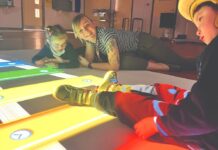
Children learn through play, through hands-on experiences with manipulatives, and through structured activities that cater to their developmental needs. You’d have great difficulty finding an Early Years setting with no creative arts area, music, construction zones, role-play corners, small world play, investigation stations, or outdoor learning environments.
This is why I absolutely love Early Years education, because of its multi-sensory, cross-curricular approach to learning. It makes so much sense to me because it’s holistic and flexible for the learner. Children can access and engage with the curriculum through hands-on activities, play-based learning, and exploration.
Early Years Education unapologetically celebrates that children are unique and learn differently—it embraces visual, auditory, kinesthetic, and tactile learning. That’s why investing in early childhood education and making learning accessible to all children is crucial, and this becomes even more important if children have undiagnosed learning needs, because these are more prevalent among children in the Early Years compared to older age groups, and this can impact their ability to thrive academically and socially.
Learning needs can be undiagnosed in the Early Years for several reasons. The natural variability in children’s development means that differences in learning styles and abilities could be considered part of ‘normal developmental variation’, rather than being seen as an indicator of an underlying learning difficulty. Awareness and understanding of learning needs among parents, caregivers, and educators may be limited during the early years, leading to difficulties in recognising and addressing potential concerns. Young children learn quickly and adapt masking behaviours or compensatory strategies to cope with their difficulties, making it less obvious that they require additional support or intervention.
Ultimately, this means some children may not receive the support and interventions they need until later in their education. Thankfully, Early Years educators often possess a remarkable ability to understand and support the needs of their young learners, regularly implementing interventions even before specific learning needs are formally identified.
I’ve often wondered, while phonics schemes are invaluable for teaching literacy skills, would numeracy schemes help improve mathematical understanding and proficiency in young children? Phonics schemes play a crucial role in teaching children how to decode words, recognise letter-sound relationships, and develop reading fluency. They have long been hailed as a cornerstone of literacy development.
The use of phonics in teaching reading dates back centuries, but systematic approaches only began to gain prominence in the early 20th century. One significant milestone in the history of phonics teaching is the publication of “The Writing Road to Reading” by Romalda Spalding in 1957. This book introduced a systematic phonics approach that emphasises phonemic awareness, phonics, spelling, and handwriting. Since then, phonics teaching has continued to evolve, with various phonics schemes and methods developed and implemented in schools worldwide.
However, just as phonics schemes provide a systematic approach to decoding words, I can’t help wondering if numeracy schemes could offer a structured framework for learning numerical concepts, such as number value and the relationships between numbers, in order to start building number sense and number flexibility in our learners.
We know that young children learn best through play-based, hands-on activities. Teaching phonics often incorporates multisensory techniques, such as using manipulatives, pictures, activities, and songs, to make learning enjoyable and accessible. Similarly, teaching numeracy includes lots of multisensory manipulatives, songs and rhymes, but could it also include more stories and pictures to provide visual and auditory cues to reinforce mathematical concepts from a younger age?
Consistency is key in early learning, and while phonics schemes offer a standardised approach for reading and writing, the absence of any widely adopted numeracy schemes can lead to inconsistencies in both maths education and in mathematical language… for example, “take away”, “minus”, and “subtract”. This can confuse our learners and put them at a disadvantage as they move through their education.
Numeracy schemes may not cater to the needs of every learner, in the same way that phonics schemes don’t work for all children, but surely they remain a preferable option to having no structured numeracy approach at all?