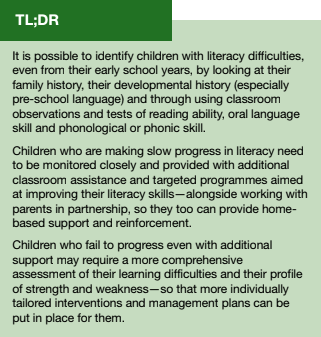
























Dr Valerie Muter has some suggestions for questions that class teachers can ask themselves (and the child’s parents) which could indicate whether a child in their class might have dyslexia or a reading comprehension problem.
Dyslexia
Dyslexia is a word-level reading difficulty characterised by lateness in learning to read and persistent spelling difficulties. Dyslexia runs in families and is often associated with delayed early speech and language development. Children with dyslexia usually have difficulty processing and analysing speech sounds. This makes it hard for them to learn how to phonically decode words they’ve not seen before.
If you are a reception class teacher, ask yourself (and the child’s parents):
- Is the child later learning to read than their classmates?
- Are they struggling to learn the alphabet letters?
- Was the child late in learning to talk or has unclear speech?
- Do they find it hard to play sound games like I Spy or rhyming games?
- Have other members of the child’s family had difficulties with reading and spelling?
If you are a Year 1 or 2 teacher, ask yourself (and the child’s parents):
- Is the child struggling with reading and behind their classmates?
- Do they find spelling hard and mis-spell even very simple words?
- Are they reluctant to read in class?
- Do they find it hard to decode words they’ve not seen before?
- Have members of the child’s family had difficulties with reading and spelling?
If you are a Year 3 to 6 teacher, ask yourself (and the child’s parents):
- Was the child OK reading when younger but is now falling behind?
- Do they read slowly?
- Do they struggle with spelling and find it hard to retain spelling lists?
- Are they reluctant to read and write? Do they actively avoid reading and writing?
- Have members of the child’s family had difficulties with reading and spelling?
If you have answered yes to at least three of the five questions in the relevant section, your pupil may be showing signs of dyslexia.
Reading Comprehension Difficulties
Here we are talking about children who read accurately and even fluently but who cannot understand and remember what they have read. They almost invariably have underlying speech and language difficulties and in particular a limited oral vocabulary.
If you are an early years teacher, ask yourself (and the child’s parents):
- Did the child pick up reading quickly but has now lost interest in books?
- Do they find it hard to understand and remember what they have read?
- Do they find it hard to follow the plot of a story or presentation?
- Do they find it hard to follow and remember a list of instructions?
- Do they seem to have a limited vocabulary and struggle to express themselves orally?
- Were they late to talk as pre-schoolers?
If you are a later years teacher, ask yourself (and the child’s parents):
- Does the child read out loud well but struggle to understand and remember what they have read?
- Do they actively avoid reading?
- Do they find it hard to follow a conversation or the story line of
- of a film or TV show, or to remember a list of instructions?
- Do they seem to have quite a limited vocabulary?
- Were they a late talker?
If you have answered yes to at least three of the questions in the relevant section, your pupil may be showing signs of a reading comprehension difficulty.

What next?
Step 1: Approach your pupil’s parent or carer and discuss your concerns with them. You might arrange a special appointment or perhaps wait for the next routine parent-teacher meeting to do this. It is important from the outset to work towards a good partnership with the child’s parents. Involving parents is critical to ensuring the child progresses well, as parents play an important role in supporting and motivating their child as well as reinforcing their learning at home. The best approach is to let the child’s parents know what you as a teacher are concerned about, while also listening to their views. It is worth writing down a list of your observations and concerns, using your answers to the questions you’ve asked yourself from the previous section of this article. Ask the parents for their views of their child’s progress in reading and writing, and also about their pre-school history (in particular their early speech and language development) and whether other members of their family have had reading and spelling difficulties. This then enables you to put together your shared observations in the broader context of the child’s development.
Step 2: Work together on a plan of action Could it be that the child needs a little more time? In which case, it is a question of keeping an eye on their progress over the next term—to see how they get on and whether their progress improves or not. Perhaps involve the class’s teaching assistant (if there is one) in providing extra reading and writing practice. Encourage the child’s parents to listen to them read for ten minutes a day and perhaps offer some tips for learning weekly spelling lists. Check on progress after a term or so. If there has been good progress, then you and your pupil’s parents will feel reassured that all is on track. If not, then it will be important to take the next step.
Step 3: Involve the school’s SENCo The SENCo will want to talk through your concerns about the child and may suggest that they be placed on the school’s Special Needs Register. This means that they will not only continue to ‘be kept an eye on’, but their progress will be monitored and extra help provided. An Individual Educational Plan will be set up for them and they may well be able to receive additional support and teaching. The extra help could take the form of a classroom assistant paying the child more attention and supporting them in the classroom or they might be included in catch-up groups. The SENCo may want to carry out some tests of the child’s learning and their literacy skills in order to get a better idea of what they know (and don’t know) and where their underlying difficulties lie. These tests might include asking them to read lists of real words and nonsense words; the latter are useful to identify if the child has phonic decoding difficulties. The SENCo might also get the child to do phonological (speech sound) awareness games, have them read a story out loud and then answer questions on what it was about, and assess their oral vocabulary. If the child continues to make slow progress after say six to twelve months, it could be that the SENCo recommends you move onto the next step.
Step 4: Carry out a more detailed assessment of their learning and their literacy difficulties This could be carried out by a specialist teacher, visiting educational psychologist or by an independent (clinical or educational) psychologist. A comprehensive assessment not only diagnoses a child’s learning difficulty, but also indicates patterns of learning strength and weakness that direct us to the teaching methods that best meet their individual needs. Getting such an assessment in these difficult times when resources are both limited and costly can be a challenge. Some parents may want to arrange and to pay for an assessment themselves. If they do decide to pursue this course of action, you may be in a position to recommend a specialist teacher or psychologist that you and your colleagues have worked with in the past. If that isn’t a possibility, you could suggest that they find a qualified teacher assessor through an organisation like PATOSS (Professional Association of Teachers of Students with Specific Learning Difficulties) or a clinical or educational psychologist listed on the British Psychological Society’s, BPS, website (note that psychologists should be Health Care Professions Council, HCPC, registered).