























Exams mean working quickly to remember lots of information, under timed conditions and on lots of things all at once. For dyslexic learners,
the challenge of exams can be even more daunting, says Holly Bolt.
Dyslexia is a difficulty with processing information. It’s an underlying difficulty that can impact reading, spelling and how thoughts are conveyed in speech and writing. All of these skills are key players in exam situations. Dyslexic difficulties can impact on how quickly written or spoken information is worked with and how information is held in mind when reading, writing, speaking or completing multistep processes. These difficulties can hugely increase the stress and anxiety dyslexic learners experience in the lead up to and during exams.
OK, exam season feels like it’s months away, but it has a funny habit of sneaking up on you. Whether you are a student, parent or teacher, there are lots of ways that you can prepare or help others to get ahead and minimise stress.
Changing a tyre
The tyre-changing analogy is a really useful one when thinking about preparing for exams. If you get a flat tyre on a cold, wet December night, you do not want to have to learn how to change it at the side of the road. Instead, you want to confidently know which tools to use to complete the job quickly and effectively so you can get on your way in the warm and dry. The same can be said about the tools to use for revision and exams; you don’t want to have to learn these as you need them during exams. Learning about how you learn and the best ways for you to revise and demonstrate your knowledge can start well ahead of exam season. Investing time ahead of revision and exam season can really help to reduce anxiety and stress and support dyslexic learners to demonstrate the depth of their knowledge and understanding in exam conditions.
Learn how you learn
People rarely have just one learning type, but we all have preferences for how information is presented and how we use this to learn. Ask yourself whether you prefer things to be colourful and visually appealing? Do you prefer to hear information? Do you learn best when you are doing? This multiple intelligences wheel is a great starting point (see Further Reading). There are hundreds of study skills guides to read and revision experts to follow online, take time to find the ones that appeal to the way you work and then trial the strategies. Don’t be afraid to adapt strategies to make them work for you.
What makes you you?
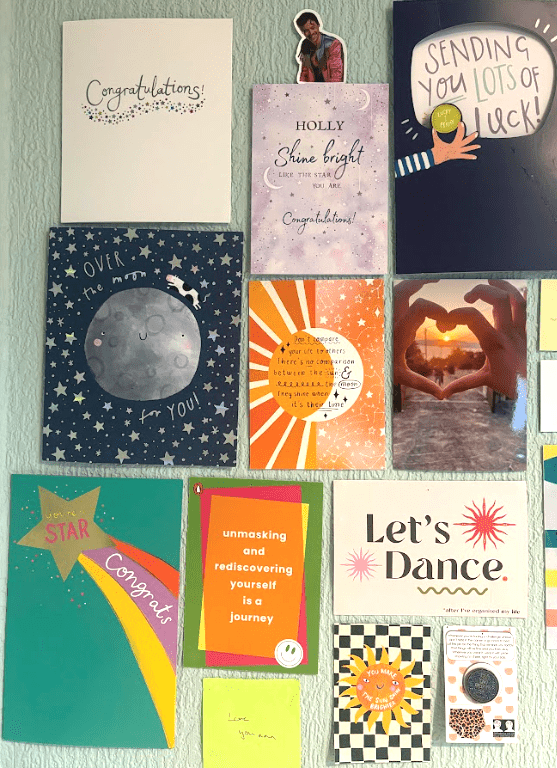
Affirmations and positive thinking are fantastic tools for maintaining self-esteem and confidence in the face of challenging situations. Making a ‘what makes you, you’ space is a great way to reflect on all the things you are amazing at. You can even ask your parents, friends or teachers to contribute the things that they appreciate in you. The space can include motivational quotes, pictures, notes and even positive feedback on your work. The best part is, you are making it, so it’s up to you how you present it and where you put it. Mine is next to my marking desk and has little reminders to keep me positive. Yes, that is a tiny picture of Harry Styles!
Personalise the strategies that work for you
Effective revision means allowing time for repetition, reviewing learning in lots of different ways, and allowing processing time. The Leitner System incorporates all three of these principles (see Further reading). Other strategies include:
- Using acronyms (an abbreviation formed from the first letter of a series of words, such as YOLO You Only Live Once) or mnemonics (a short phrase to remember key information, such as Big Elephants Can’t Always Use Small Exits to remember the correct spelling of because).
- Building associations. By building a story or linking information to a familiar journey that you can ‘walk’ through in your mind, you make links between things you are familiar with and things you need to remember. Another way of doing this is using a ‘mind palace’ or the method of Loci.
- Incorporating physicality. You could go for a walk while you listen to information, or you could repeat information aloud while practising football skills. You’ll get some exercise and get your blood flowing, with the added bonus of revising while doing something you enjoy.
- Teaching someone else. Being the expert in the room not only ensures that you know your stuff, but it also helps you to build confidence in your knowledge.
- Sketchnoting. This turns chunks of text into images, diagrams, and flow charts. See Further Reading
- Practising active recall. Active recall applies your learning to the types of questions you are likely to come across in the exam. This puts what you have learnt to the test in low stakes situations, meaning you can see what you know and build exam strategies, without worrying about the marks or the time allowance.
- Developing model answers for tricky questions. By building a model answer, you can complete ‘perfect practice.’ After all, ‘perfect practice makes perfect.’
Plan to manage the stress ahead of time. Look up your exam dates early so you can be sure of your time frames. Plan backwards from exams so that you know exactly when you would like to be doing each stage of your revision. Plan kindly. Remember to approach revision like a marathon rather than a sprint. Little and often over a longer period of time will take into account your schoolwork, your hobbies and enable you to build in vital rest and relaxation time. Use the Pomodoro technique to manage your work and break times. Choose a subject or topic to revise, set a timer for 45 minutes (or however long you can comfortably concentrate for), revise. Once the timer goes off, have a 5-minute break to grab some food or get some fresh air and then start again. Repeat four times and then have a longer break. Like the Couch to 5k, but for your mind.
Look after your mind, body and soul throughout. Go back to your affirmations to keep up the positivity. Eat well. Foods that are rich in flavonoids have been found to enhance working memory so include lots of berries, dark chocolate and vegetables in your diet. Rest. Try to build a good sleep routine and definitely have time away from your studies to do the things you love.
Plan for the day. Find out everything you need to minimise anxiety ahead of each exam. It will help to plan timings, route and anything you need to take with you. It can be helpful to develop a plan for each exam too. You can do this by looking at the marks available and the time you have in the exam to build a time plan.
During the exam. While you have been active-recalling and perfectly-practising, you will have developed strategies to help you to perform at your best under pressure. Use these to show off all your wonderful knowledge to the examiner on the day. Take the opportunity to shine. At this point, you will have worked long and hard, so show off what you know and can do.
After the exam. Celebrate with something you enjoy: it could be a film with friends, baking a cake, going for a walk. Taking time to decompress will help you recognise your achievements and get ready for the next exam. Take time to reflect. What went well? Is there anything you could tweak in your revision or exam strategies ready for the next exam?
Further reading:
Multiple Intelligences Wheel
https://whatsyourstrength.co.uk/wp-content/uploads/2023/09/Multiple-Intelligences-Wheel_CU.pdf
The Leitner System
https://subjectguides.york.ac.uk/study-revision/leitner-system
Sketchnoting
https://sketchyideas.co/sketchnotes/