

















Vicky Perry enthuses about getting your hands dirty, and powerful learning experiences in the great outdoors.

We’re fortunate. Our school sits in large wooded grounds in the beautiful Surrey countryside, so there is plenty of capacity for outdoor learning. It’s a unique and special place to work and learn. Inspired by the Scandinavian education system, we introduced Forest School more than ten years ago, beginning on a relatively small scale, and fairly basic, but today’s Forest School is more advanced and makes great use of the abundance of natural resources at our fingertips.
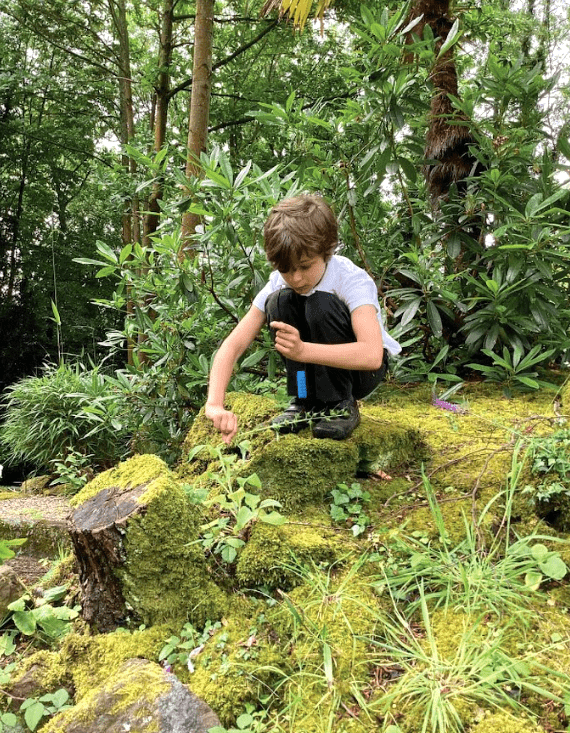
Our Forest School is divided into two camps, lower and upper, so we can tailor the resources to younger and older students. Across the two camps are different zones—safe spaces free of any hierarchy to create a sense of independence where young people can let their imagination run wild. The sites are beneath a collection of extremely tall trees in established woodland. It’s a multi-sensory experience with canopies, parachutes, hammocks, shades, shelters, ropes, swings, a mud kitchen, a digging zone, a huge campfire and the beginnings of a treehouse.
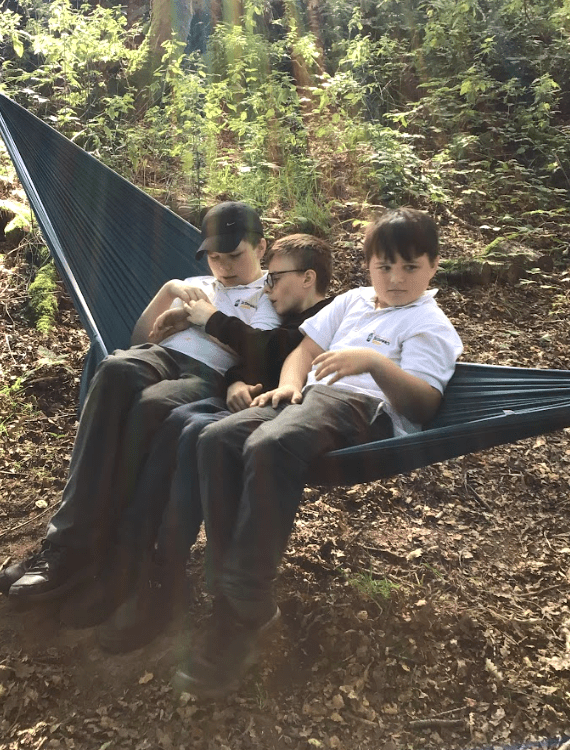
The lower school camp is centred around unstructured, learner-led discovery, meaning it’s guided by the students themselves. There’s lots of hands-on physical activity and imaginative play, including climbing trees, playing hide-and-seek and digging. There’s also time for reflective practice and relaxation, which is where the hammocks come in handy.
While our Forest School establishes physical and behavioural boundaries from the start, children have an opportunity for physical, social and emotional risk-taking from a young age, and appropriate for them as individuals. For those who don’t like getting dirty, being in a muddy woodland environment means they are taking a risk. Equally, climbing a tree, using tools, or being exposed to flames around the campfire are all risks that help equip young people with knowledge-gathering to build critical thinking skills and self-belief. It’s about supporting the students’ personal learning journey, and as they move into the upper camp they begin to engage in different experiences.
The upper school camp is set up to host more mature and complex activities which are better suited to older students. Bushcraft tools and techniques feature heavily here, and students may take responsibility for lighting and maintaining a fire, or practise sawing and splitting logs. They may also cook, prepare and eat around the open fire, taking responsibility for all the roles and tasks to ensure it runs smoothly and safely.
The provision in both camps is set up to cope with most types of weather, and even rainy days don’t dampen our spirits. Students and staff don their wellies and waterproofs and off they go. It’s that sense of adventure that prevails, come rain or shine.
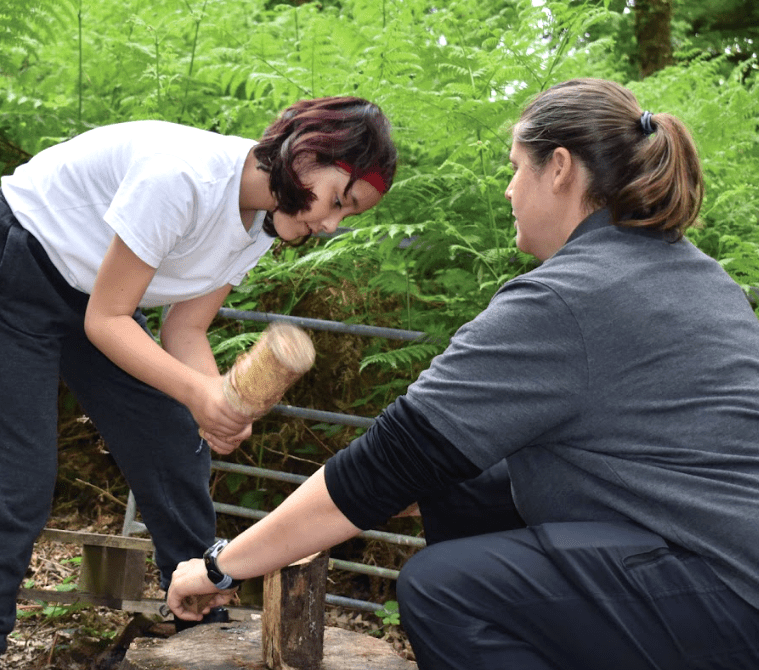
Forest School is an established part of our weekly timetable. By participating in regular sessions, our students are growing alongside Forest School, and will reap the benefits for years to come. Outdoor learning helps young people to grow in so many ways and the impact is incredible. Being in the great outdoors supports mental health and wellbeing, as well as emotional and behavioural regulation. We quickly see students build their independence and self-confidence through exploring the outdoors in their own time, at their own pace. Students also mix more and connect in different ways with their peers as their social, communication and language skills are enhanced.
Adam
In a classroom setting, Adam faced ongoing challenges. He found it difficult to engage with learning. However, there was a complete transformation when Adam stepped outside to Forest School. This was an environment in which Adam shone. It was just the learning environment he needed. He soon developed a love of Outdoors and immersed himself in all the opportunities it offered. He worked with bushcraft tools, discovered a passion for bird watching and developed a robust understanding of camouflage. He has continued to build on the skills, knowledge and understanding that he accumulated at Forest School, and he has achieved a well-deserved distinction for a BTEC in Land Based studies. Adam has set his sights on agricultural college next, to pursue his love of the outdoors.