





Jonathan Powell writes about the progress made by Astronomy in accommodating people with hearing difficulties. The answer lies at least partly in sign language.
The wider use of the most commonly used sign language in society, BSL, has given meaning and purpose to many in the UK who have hearing difficulties. The once closed door has opened to allow everyone to be seen, heard and recognized for talents that far transcend their sensory disability. And those who teach sign language are being recognized for the time and effort they invested in empowering people with hearing difficulties.
The British Science Association (BSA) has identified underrepresentation of deaf students in the fields of science, technology, engineering, and mathematics, and a shortage of assistance required at university level. The BSA also referenced a further underrepresentation of the deaf community in the UK workforce in general. However, Astronomy has made great steps to improve the involvement of those with hearing issues. There are people striving at both amateur and professional level to make the subject as inclusive as possible, and in doing so proving that no boundary exists for those who not only wish to be involved in an amateur capacity, but who want a career in the field.
Astronomy and sign language
In 2015, the International Astronomical Union released a report recognizing that many astronomical words had no sign language equivalent. As part of an effort to redress the balance and to reach deaf communities around the world, the first international list of astronomical words in sign language was released. The list included forty-seven words most used in the education sector. Dr Olja Panic, an astrophysicist at Leeds University, warned that the deaf community was at risk of being excluded from the sciences, including astronomy, because the number of new advances was outpacing the development of sign language to accommodate them. Dr Panic set out on a project to create fifty new signs that would cover her work in the field of planetary systems.
Astronomy in the deaf community
In recent times, several people have tasked themselves with strengthening the bond between astronomy and the deaf community. Derek Rowley is founder of the British Deaf Astronomical Association (BDAA). He has been involved in the BBC television programme See Hear, and took part in a BBC News item regarding the risk of deaf people being excluded from astronomy. Several astronomical societies have outreach officers. Rachel Dutton is a partially deaf amateur astronomer managing outreach for Guildford Astronomical Society, Her work includes coordinating observing meetups, talks to local community groups and webinars. Somewhat ironically for someone partially deaf, she also presents ‘Stars Over Surrey’ for Brooklands Radio. Rachel highlights some of the biggest barriers to the participation in astronomy for people with hearing loss, including difficulty with presentations and talks without subtitles, and with little or no amplification, where there is background noise or the speaker is not facing the audience.
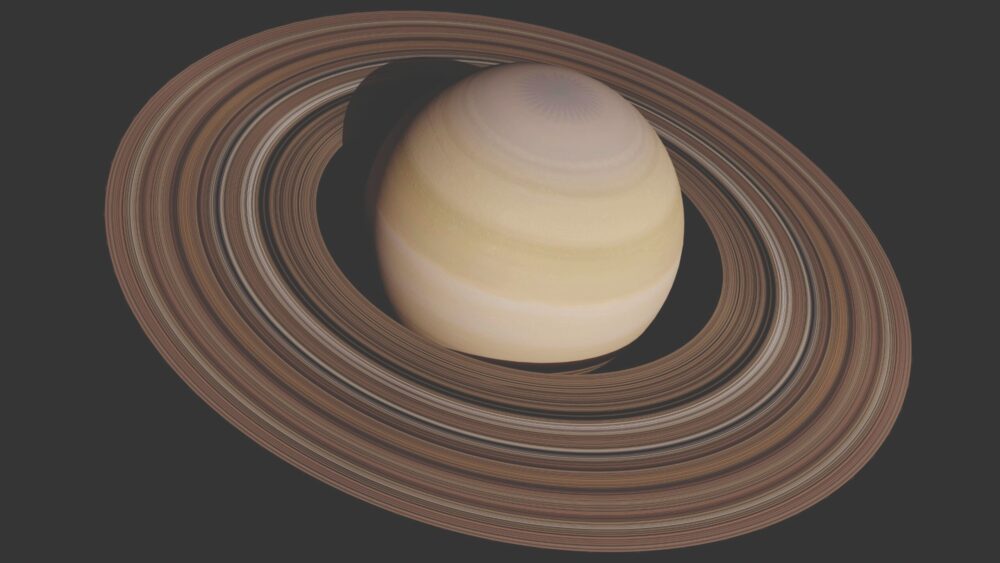
A network of educators who bring astronomy directly into the classroom have made an impact in mainstream schools, in special schools, and in individual home teaching. Oxfordshire based Dr Sarah Bearchell is founder of Children’s Science, developing and presenting her own hands-on, multi-sensory science shows for special schools and wider audiences: I use Makaton, a spoken-signing language often used in special schools, to support ideas. I often borrow from BSL, because many of the signs convey the meaning of a word, even if you are not fluent in BSL. For example, to sign “Saturn”, you make your less dominant hand into a fist and use your dominant hand to indicate the rings around it. The Scottish Sensory Centre has produced an amazing glossary of scientific signs. I love it when audience members teach me new signs—it helps to raise awareness of signing among everyone in the room.

Sign language for all
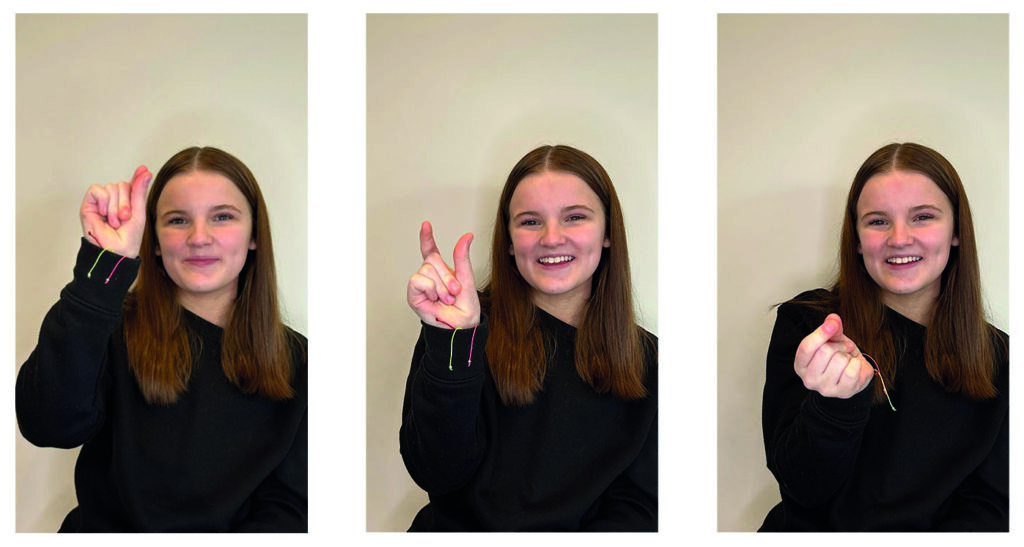
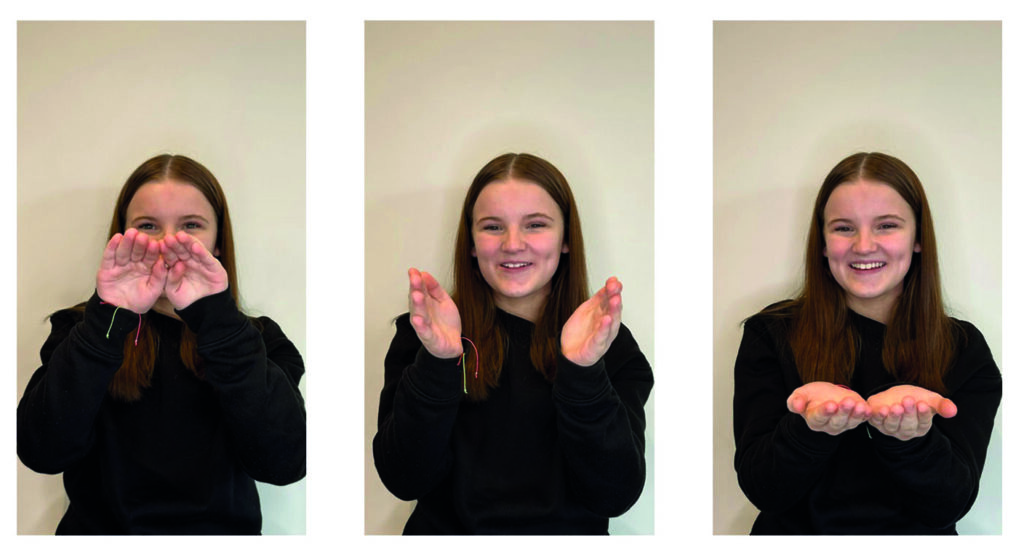
There are some words in astronomy that we can all attempt to sign, and a young lady named Eve has been enlisted to help. Eve is from the social media outlet Let’s Make a Difference which incorporates a youth element and the promotion of sign language in society. Let’s Make a Difference has social media presence on Facebook, Instagram, and YouTube, with the aim to bring sign language firmly into the public domain and open a portal for anyone so inspired, to consider learning BSL for themselves or indeed, introducing it into their own particular interest or social outlet. Eve personally commands a substantial following on a variety of platforms with over one million followers collectively. Eve’s own interest in astronomy, along with other family members, incorporates regular sessions spent identifying stars and constellations with the use of a mobile telephone app. Eve says the sessions bring great enjoyment for all involved, so much so that she wishes to share some of the basic sign language used in astronomy with the SEN readers (see pictures).
Artificial Intelligence
Artificial intelligence is expected to have an impact on teaching of sciences and all disciplines. In an EU funded project from 2019 to 2023, those closely involved with AI and the deaf community examined the possibilities of such collaboration and how it could evolve to become a part of everyday life. Sotirios Chatzis, an associate professor at the Cyprus University of Technology said: Using emerging technologies, we created some innovative solutions to help deaf and hearing people communicate with one another. One such solution was an on-demand sign language-generation application.