























Katie Dooley Cawley and Hannah Brown investigate the evidence around the effectiveness of teaching Makaton to people with learning disabilities.
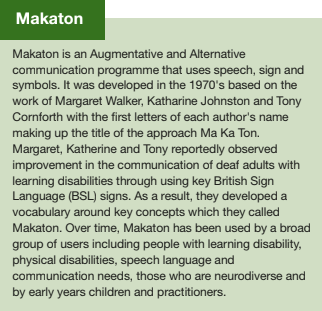
As Speech and Language Therapy clinicians, we are accountable to practice in a way that is evidence based. This includes combining understanding of the best available evidence with clinical experience and feedback from the service user to inform practice. For Makaton, we understood our own clinical experience in using the approach, and we could monitor how the approach was being experienced by service users, but we did not have a thorough and critical understanding of the published evidence underpinning it, so reviewed the evidence on the use of Makaton signing alongside speech. Our aims were to explore and evaluate the available evidence for Makaton signing as an approach to develop communication skills, to investigate how Makaton signing was implemented and sustained, and in particular what techniques were used to support people to learn the signs and to continue to use them over the longer term. We also looked at the impact of learning and using Makaton signs on individuals and their communication partners.

Our research
With help from library services in our NHS trust, we searched electronic databases for published articles about the use of Makaton signing with people with a learning disability or their communication partners. We applied no limits to the date the articles were published or the type of publication. We appraised the quality of the included articles using published critical appraisal tools. This helped us to understand how much we could trust that the findings were reliable and replicable. We looked at the methods used in each study and pulled out what behaviour change techniques were used, based on behaviour change taxonomy. This helped us to see what techniques were used to support people to learn and use Makaton signing. Finally, we looked at the perspectives and experiences of users of Makaton signing documented in published literature.
We found 81 records in the initial search which our team reviewed. Eleven articles published between 1983 and 2022 passed screening and were included in the final review. The articles included qualitative studies, case reports, cohort and quasi-experimental designs. Six of the eleven studies described methods in enough detail to code the techniques used to teach Makaton. The three most frequently-used techniques were monitoring of behaviour (counting signs used), demonstration of the behaviour (tutor modelling of signs) and behavioural practice and rehearsal (systematic sign practice). Other techniques included social support (eg buddy systems), prompts and cues (eg pictures of signs) and environmental structuring (eg signing groups andvisual aids).
Users’ perspectives
The three broad themes emerged from the articles. Firstly, users and their communication partners consistently reported that Makaton fostered both basic communication skills (eg signing vocabulary) and broader learning abilities. For example, participants noted rapid gains in expressive signing, and carers observed deeper engagement through combined music-and-sign approaches in choir sessions. Secondly, participants described improved expressive and receptive abilities: more frequent initiations, clearer need-expressions, and a marked reduction in frustration. One user reflected, Makaton gives people a voice…helps people to develop their signs and then use them in everyday life, illustrating enhanced mutual understanding. Thirdly, although gains were evident in structured settings, several reports warned that sign use declined when environmental or staff support lessened. Moreover, Makaton appeared to act as a communicative scaffold rather than a springboard to wider language acquisition, with little evidence of sustained vocabulary growth beyond the intervention context.
Conclusions
The evidence review indicates that, despite a broad search covering studies from 1983–2022, the overall quality of research on Makaton ranges from low to medium, with qualitative work generally more methodologically robust than quantitative reports. An analysis of themes revealed that Makaton users report that it supports both skill acquisition and enhanced expressive/receptive communication, reducing frustration and promoting interaction. Behaviour‐change coding showed that monitoring, demonstration and rehearsal were the most used techniques. However, gains often failed to generalise beyond structured settings, and there’s limited evidence that Makaton use drives longer-term language development. In summary, Makaton is a valuable scaffold for improving immediate communication and learning skills, but high-quality, standardised research is needed to confirm its wider and sustained impact.

Limitations
There are a few key limitations to be aware of in this review. First, due to limited research on Makaton, we had to include a wide range of study types, from case reports to qualitative and quasi-experimental designs. Many quantitative studies lacked detail, making it hard to assess reliability or replicate their findings. Five studies didn’t describe their methods well enough to code for behaviour change techniques. The variation in study design also made it difficult to compare results or draw consistent conclusions. And finally, studies ranged from 1983 to 2022, meaning research quality and standards varied over time.
Recommendations
Based on our findings, we’ve made several recommendations for clinical practice and future research. Clinicians should be familiar with the current evidence around Makaton. While it’s commonly used and valued, the evidence quality is variable, so it’s important to make informed, balanced decisions. Makaton can support both expressive and receptive communication. It should be considered as one part of a wider communication approach, especially for people with learning disabilities. While Makaton helps with basic communication, its impact on full language development may be limited. So, expectations should be focused on practical communication gains. When delivering Makaton interventions, include techniques like modelling, repetition, and environmental supports, such as visual prompts and consistent use across settings. Finally, clinical teams are encouraged to document outcomes, share best practices, and to carry out small-scale evaluations to strengthen future evidence.