





















Rosaline Van de Weyer on the importance of developing confidence in young people with Developmental Coordination Disorder, also known as DCD or Dyspraxia.
DCD is primarily a neurodevelopmental condition, in which a reduction in motor skills adversely impacts activities of daily living. Examples include self-care: toileting, washing, drying, hair washing, dressing, fastening shoes and clothing, domestic tasks: opening packets or lunch boxes and manipulating utensils, sports and handwriting to name a few. DCD can also impact upon executive functioning skills such as planning, organisation and prioritisation of tasks. So, it is not surprising that many children with motor skill deficits may significantly struggle with confidence and self-esteem in relation to a wide variety of tasks, not only activities associated with motor skills.
A child’s core daily occupations are play and education, which of course encompass many motor skill demands. The evident issue for young people with DCD is that elements of their motor skills are far below what are expected for their age. This motor skill lag is noticed by parents, peers, teachers and support staff and is commented upon and at best supported. It is accepted that children develop self-insight around the ages of seven to eight. During this time, they form the ability to compare their activity performance with their peers. An acute example is handwriting. This is part of the curriculum and as such is taught and assessed regularly with feedback. Pen licenses are an incentive for some children, while being a torment for others, who are trying hard but are not yielding the same results fast.
Factors which influence mental health and wellbeing are the ability to adapt, cope, adjust and manage demands. Therefore, supplying scaffolding strategies to support physical daily activities are essential, alongside theoretical learning aims. Here are some suggested classroom-based strategies which can support focus, motor skills, executive functioning and the development of self-efficacy—the belief that one can achieve a set task.
Maintaining focus
During focused work such as writing or reading activities, seat a child with DCD at the end of a row or at an individual workstation, ideally away from the door or classroom walkway.
Noise cancelling headphones are excellent for children who need more assistance with task- specific focus (not all the time).
Encourage the whole class to engage in short bursts of movement activity prior to focused work. For example, do a big stretch and jump on the spot ten times, and heads-shoulders-knees-and-toes every twenty minutes. This aids physical regulation.
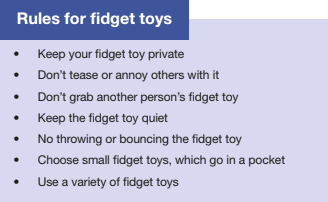
Trying to stop fidgeting is an exercise in futility. It is better to find acceptable ways to channel the need for movement. In a classroom, small subtle movements are less distracting than the big ones (like falling off a chair, which can happen if you request that children sit very still). Suggestions of successful fidget toys include: Blu Tack, a rubber band, a smooth stone, a small textured ball, an object on a key ring. If the fidget toy is used to make a noise or distract others, it should be taken away for a time. Initially the toys may have a disruptive novelty factor, but this will wear off. The toy must fit into the child’s pocket
Dressing
A key moment in school is changing for PE or outside activities. In reception and primary school classes, reinforce the methods for getting dressed: Ensure the clothes are not inside out (show the seams are on the inside). Orientate the clothes face down on a flat surface with the label in the back of the clothing to put on. Prompt children to look at their shoes to establish left and right. Encourage small markers or stickers inside (red for right) to help with this. These consistent prompting strategies will help with learning, skill acquisition and speed of performance over time in the school environment and at home.
Sport
Children with DCD may have innate challenges with some or all of the following: Difficulty with rhythm, timing, spatial perception, bilateral coordination and processing the need for movement is a timely way to organise a physical response. All of these issues make team ball sports hard and a moment of challenge. It is agreed that practice helps, but not at the expense of mental despair. Being put in goal is not helpful and intensifies all of the above. Encourage individual fitness, one mile a day, Park Run and dancing. Not being proficient or enjoying team sports should not curb the enjoyment of bodily movement and a healthy lifestyle. A child with DCD may be a good person to help learn refereeing or linesman skills (watching will facilitate learning and contribute to the game), or helping get the equipment out and putting it away—all key roles in professional sport.
Handwriting
Consider the 4 P’s of handwriting, below. These are all helpful areas for consistent feedback. The National Handwriting Association (UK charitable organisation) has some excellent resources for professionals, students and parents.
Posture (feet on floor for stability).
Pencil grip—is it functional and pain free?
Pressure on the page—are the marks too dark or light?
Paper position.
In adulthood, many of us type as our usual way of writing longer pieces of text. Therefore, incorporating meaningful handwriting goals (alongside curriculum requirements) into teaching is essential for positivity. For example, practise name writing to develop a signature the child is proud of. Making a signature wall might be a fun thing to do and revisit at regular intervals to practise or develop. Children with DCD often have poor self-esteem and experience shame around untidy handwriting. It may cause the hand to ache too, for double measure. Therefore, encouraging self-expression in the form of a signature that will be used for the duration of their lifetime is time well spent.
These days, handwriting is arguably only used only for list making, notes, birthday cards, filling in a basic form, signatures and love letters. However, the developmental benefit of learning and practising handwriting (even alongside typing) has shown to have significant neurological and physiological benefits.
Performance
Bringing some happiness and sense of achievement into each day is something we all strive for. Teaching a child reflective skills, to monitor both performance and feelings, develops a sense of self, and trust that perseverance with challenging tasks or trying different ways around them will deliver a worthwhile result. The Cognitive Orientation to daily Occupational Performance approach (CO-OP) is helpful. A goal is set, the activity planned out step by step, undertaken, and reflected on: Goal, Plan, Do, Check. Then the goal can be adjusted for another go until success is achieved. This works very well for children who are cognitively able to engage with this approach.
DCD, like other neurodevelopmental conditions, is often hidden. These children are often cognitively able who have much to offer the world. A few thoughtful adaptations, together with an encouraging kind word, will help the majority of young people with DCD navigate their school years and beyond.