

















Trond Ola Tilseth reports on a clinical study into the use of virtual reality (VR) to alleviate symptoms of ADHD.
Sixteen-year-old Arturo has become better at organising his life with the help of a VR headset. Together with over eighty other children and young people with ADHD, Arturo has participated in a unique research project at the University of Granada. “This virtual training has definitely improved my real life,” says Arturo, who is from Málaga (we have changed the names to comply with Spanish laws on the protection of minors).
After twelve sessions over three months, Arturo completed the programme, in which he practised daily tasks in virtual reality.
Behind the project, which began in December 2022, is an interdisciplinary team consisting of paediatricians, general practitioners, psychologists, occupational therapists, and IT technicians.

“We saw that there was an unmet need in support services for people with ADHD. Our project has focused on enabling participants to plan their activities better and organise their time. These are important skills that enable us to function as social beings and as independent individuals,” says psychologist and occupational therapist Dulce María Romero at the University of Granada. According to the professor, previous programs in the field have mainly focused on strengthening the concentration of participants, often with tests that are not particularly relevant to their everyday lives. “We wanted to achieve something that could be transferred to the daily lives of children and adolescents with ADHD. The goal is to make the children more independent.”
Entering a new world
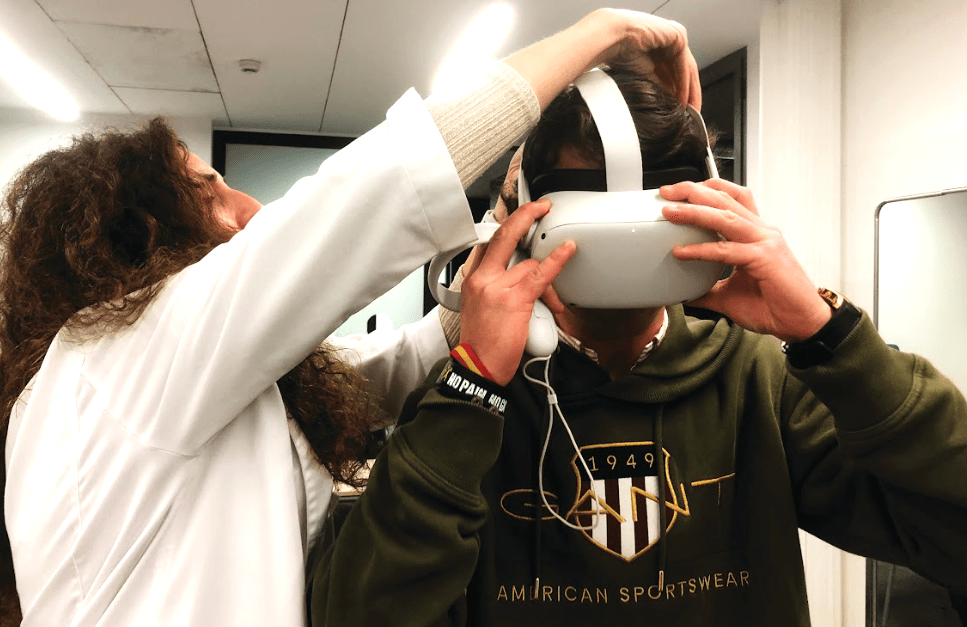
When Arturo and the other children put on the VR headset and the game controllers, they are transported from the Health Sciences faculty of the University of Granada into a virtual world, where they can move around a home and perform tasks with their hands, or wander around a bustling city, buy goods in shops, and observe everything that happens. At the same time, they can hear the tasks given to them by Dulce or her assistant Carmen Vidal Ramírez, who speak to them from the outside world:
“Today you’re going to make a packed lunch with ham and a juice box, then you need to go up to your room and get your English, Maths, and History books. After that, you should go to a bookstore to buy the book ‘The Dream of Berlin’ and some writing materials. Also, let us know when you think ten minutes have passed.”
While Arturo is busy solving his tasks, the occupational therapist explains why they are so focused on teaching the children to “feel” how much time has passed.

“Having control over time is very important for functioning in society. When you have ADHD, it’s common to completely forget about time; it just passes without you making any progress on what you’re supposed to be doing,” says Romero.
She explains that each treatment session has a physical and a virtual part. In the physical part, which can be individual or group-based, they go through the day’s topic and the strategies they will practise. The children set their own concrete goals related for instance to school performance or emotional regulation.
Arturo is open about his own challenges in managing anger and frustration. Therefore, during the program, they have trained on strategies he can use as an alternative to immediate reactions when something provokes him.
“I’m a nervous type, so they have taught me different things. One of them is to tense the muscles in my feet and fists to calm down the anger. Another is to focus on the landscape around me, or concentrate on my own breathing. Then I somehow have to recognize the feeling of anger that arises and tell myself, ‘now, Arturo, you need to breathe for a few seconds before trying to solve the problem’. I know that if I just get angry, I’ll only lose,” he says.

Like a video game
Provocative things can happen in the virtual world too. It is not easy to slice bread when the whole loaf keeps falling on the kitchen floor. Furthermore, it can be frustrating when you try to open the fridge door and fail.
“I remember a particular task where we had to prepare a meal to share with four others. In real life, I am a terrible cook, and it wasn’t any easier in VR. The nice thing, though, is that it’s like a kind of video game. You get excited to keep trying until you get it right,” says Arturo.
Throughout the treatment program, he has gone through various types of games in VR. While some have been about planning in time and space, such as organising a route to five different destinations, others have focused more on concentration exercises. In one of the games, for example, Arturo had to press the correct colour when a voice said either “red,” “green,” or “yellow.” In the next difficulty level, he had to press red when the voice said “green,” yellow when the voice said “red,” and green when the voice said “yellow.”
“This was very difficult at first, but in the last sessions, I managed this too. I’m completely sure that this type of training has made me better at taking notes at school, for example,” says Arturo.

An ideal calendar
In one of the group tasks, the children, along with their parents and professionals, worked on creating their own schedule.
“We see that many of the children struggle to use the timetables or calendars they receive at school. They lose them or forget to use them. That is why we worked on designing an ideal calendar for them, where the children themselves made specific suggestions for what would be useful for them. In addition to daily plans, they wanted fold-out weekly and monthly overviews, and especially room for a separate list of important tasks not tied to a specific date,” says the professor.
Arturo, who has been listening, interjects. “I used to have three or four books to write tasks in, but I couldn’t use them, or I left them in various places. This year, I have managed to stick to just one, maybe because I helped design it myself. I use it every day. It’s nice to be able to cross out the tasks I’ve completed,” he says.

Age-adapted approach
The program Arturo has been through with over eighty other children aged 9 to 16 is part of a clinical study. The children wore heart rate monitors while completing tasks, and both they and their parents filled out forms answering how they felt about the program both in the real and virtual worlds. Dulce María Romero and her team are now waiting to have a research article accepted in a scientific journal.
“We see that age has a lot to do with the type of everyday challenges the children face and how well equipped they are to solve them. For the younger children, school and preparations for it are most important; getting up, washing their faces, preparing their backpacks with the right books and lunch. For the older ones, it might be about organising a birthday party or planning a weekend trip with friends.

“The older children have typically trained a greater ability to concentrate than the younger ones, but they still have challenges related to planning and organising their time, which also affects their social relationships. They typically arrive late to appointments, miss the bus, or forget to get off at the right stop,” says Romero.
Tools for the future
In a room next to where Arturo has been in VR, we meet ten year-old Pedro and his mother Beatriz. Pedro is noticeably agitated. He speaks quickly and fiddles with his mother’s phone as he talks.
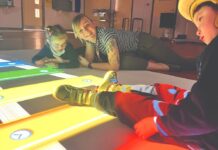
“I’ve been here ten times and I’ve learned to use the VR headset. Plus, I’ve done exercises with blocks,” says Pedro.

His mother explains that they heard about the study somewhat randomly and that they enrolled Pedro in hopes of contributing to better treatment of ADHD symptoms. “This seemed very interesting. But to be completely honest, I’m a little disappointed because I haven’t seen any results on Pedro in everyday life yet,” says Beatriz. As Professor Romero says, most people in the experimental group have made progress, but not everyone.
“We also have to take into account that their everyday lives affect the outcome of the treatment. Some have problems at home or at school, and situations can arise in life that affect their development,” says the psychologist. She is confident that VR will become an important tool in the future in the field of ADHD.
“But it has to happen in a controlled therapeutic environment, with games tailored to the children’s everyday lives. We are constantly developing the games and adding new elements like school situations, supermarkets, subway and bus. We are also working on a solution where the game reacts directly to hand movements without the children having to hold game controllers. One of the advantages of this system is that we can evaluate the children in a realistic way, while they perceive it as a game.” says Dulce María Romero.