



















Fidelma Healy Eames on supporting gifted learners who also have a specific learning difficulty.
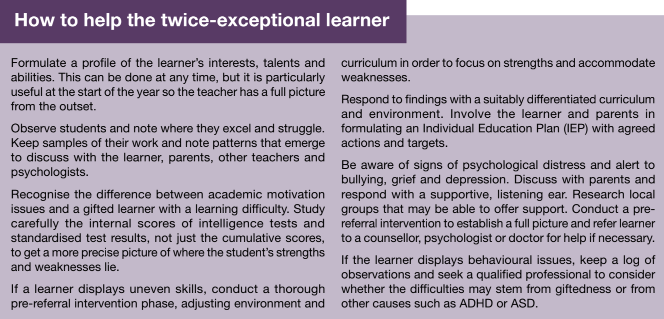
For some gifted learners, underachievement occurs as a result of co-existing special needs. Such needs may include a wide range of conditions including learning and/or emotional problems. These gifted learners are referred to as ‘twice-exceptional’ learners. ‘Twice exceptional’ (2e) is a term used to describe learners who are gifted and also have a specific learning difficulty; approximately one in six gifted learners falls into this category.17 Twice-exceptional learners are more likely to experience underachievement because often efforts to address their needs may focus more on the remediation of difficulties than on the development of their strengths and talents. Furthermore, programming for these learners can be difficult because their abilities often straddle both ends of the bell curve, with strengths and weaknesses needing to be simultaneously addressed in order for interventions to be successful. Research indicates that many ‘twice-exceptional’ students underachieve in school. A study of high-ability students with learning difficulties who were successful in higher education found that many of them had experienced periods of underachievement in primary and/or secondary education. A problem that may arise is understanding the difference between gifted learners with motivation issues, and those with a specific learning difficulty. Some gifted learners may even underachieve deliberately in order to fit in.
Luka’s underachievement is not due to a learning difficulty; rather, it is due to his inner struggle to cope with giftedness.
“I had a slight fear of being classified as nerdy – felt insecure when confronted with things I found difficult or things I didn’t excel in – and I let that affect my overall confidence in my ability. Maybe a lack of general opportunity at a young age to showcase more niche abilities (I always wanted to do a spelling bee, for example). In secondary school, I was more concerned with social ability than academic. It wasn’t until final year in university when I cut down on partying and started actually going to the library and working on my thesis, that I remembered I was very good at academia and writing.”