















Shelby Mercer’s candid account of her special school’s journey to phonics for all.
Over the past few years, we have been on a journey to enhance our reading curriculum—more specifically, our approach to teaching word recognition. Our journey, or at least our starting point, may not be dissimilar to other specialist schools. Unlike our mainstream counterparts, specialist schools lacked guidance on teaching our pupils to read until the Department for Education’s Reading Framework was published in 2021. A note to specialist provisions, included on page 79, states: Attainment may be different, but the process of learning to read is the same for those with moderate to severe SEND and complex needs. This, paired with the increasing body of evidence for systematic synthetic phonics (SSP), clarified how the teaching of reading should look in our provision.
If I use Scarborough’s Reading Rope to reflect upon where we were previously, we were certainly better at teaching language comprehension. Due to our passion for providing our pupils with a wide range of experiences and our focus on communication skills, pupils were given lots of opportunities to build their vocabulary and understanding across the curriculum. We were certainly ‘twisting in’ the fibres of background knowledge, vocabulary, language structure, verbal reasoning and literacy knowledge—but an eclectic mix of methods in an attempt to ‘do some phonics’ had left weak word recognition strands in our pupils’ ropes, meaning we had few fluent readers.
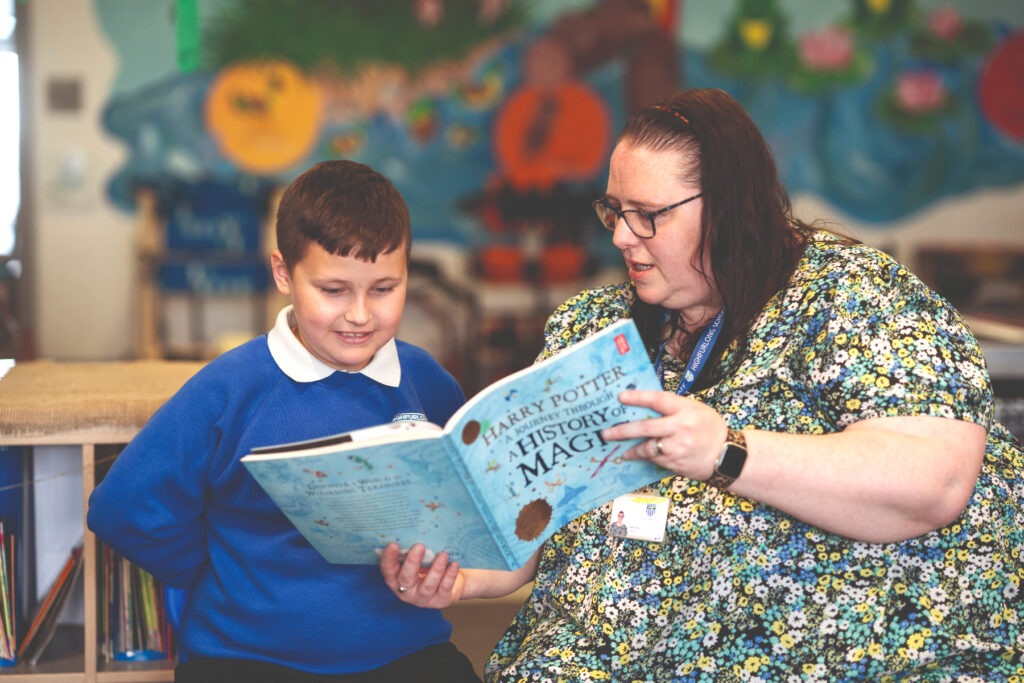
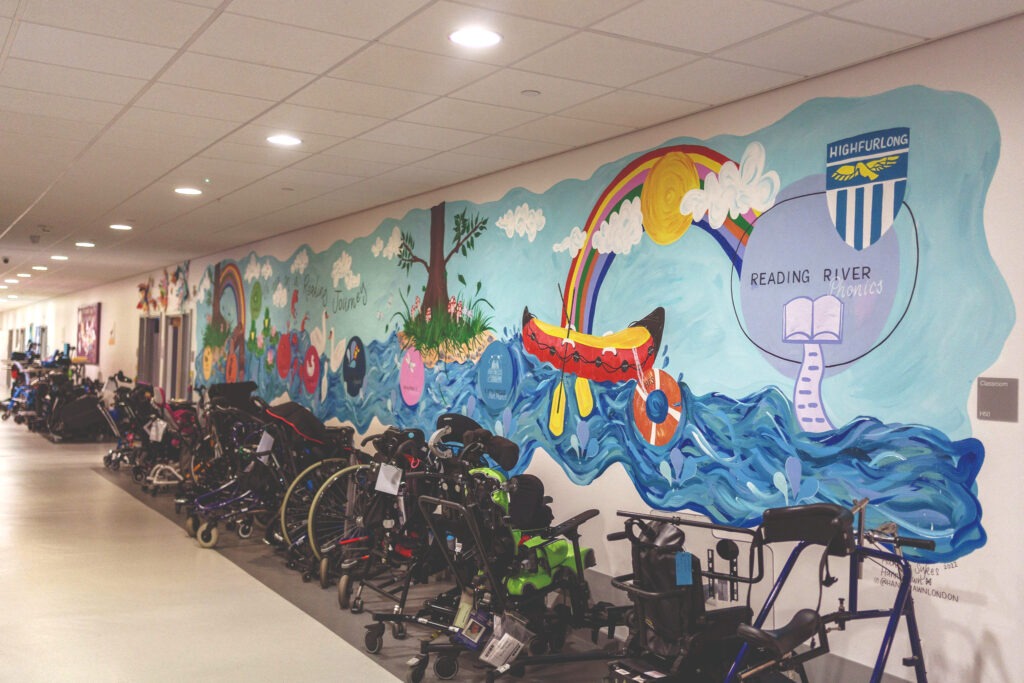
Although reading is not just phonics, it was clear for us that a focus on a whole-school approach to accessible SSP needed to be our next step. After researching the available validated SSP programmes—which are mostly designed for mainstream pupils in their first years of school—we chose to develop our own approach based around Letters and Sounds. We call this our Reading River.
Our Reading River phonics approach
Reading River is designed to be inclusive, consistent and responsive to the needs of our pupils. All learners accessing phonics, up to nineteen years old, take part in daily sessions, grouped by phonics phase, ensuring targeted teaching that meets pupils where they are. Teaching is multi-sensory, using concrete resources, visuals, songs, movement and real-life context to make learning meaningful. Formative assessment is embedded throughout, allowing staff to adapt teaching in the moment and over time, ensuring pupils revisit and secure each concept before moving on. Key to our implementation was the comprehensive staff training in SSP, alongside tailored adaptations for our pupils, ensuring everyone understood how to deliver phonics effectively in our context. This included all of our teachers and support staff who all play an important role.
Pacing for progress
It quickly became clear that, for phonics to be meaningful and successful, it needed to be delivered at a slower, more carefully considered pace. While the core principles of SSP apply to almost all of our learners, our pupils often require additional time to process, retain and generalise new information. Many experience challenges with working memory, speech and language, or cognitive processing, which can impact their ability to keep up with the rapid progression typical of mainstream SSP programmes. This is a journey our pupils may be on for several years.

Slowing the pace allows us to revisit and reinforce key sounds, build secure blending and segmenting skills, and, most importantly, ensure pupils experience success at every stage. In doing so, we strengthen the foundations of word recognition, ensuring no strand of the reading rope is left untwisted.
Inclusive practice
I previously suggested that the principles of SSP apply to almost all of our learners. As a school that educates children and young people who have complex learning needs and additional significant difficulties such as physical disabilities and sensory impairments—often referred to as pupils with Profound and Multiple Learning Difficulties (PMLD), we had to consider whether phonics is appropriate for these pupils.
Some argue that such instruction may place unrealistic expectations on pupils for whom symbolic representation and speech may not be achievable. Others maintain that while traditional phonics methods must be radically adapted, all pupils have a right to access literacy learning. On that final point, we agreed. Every child can access literacy, and our aim has always been to provide rich, engaging sensory experiences that build attention, anticipation, and communication. But does this include adapted SSP? Inspired by our pupils and the experiences of young people like Jonathan Bryan (Teach Us Too), we have to presume competence for these pupils. Like their peers, they begin as a Phase One Duck. During these sessions, we lay the foundations for literacy in the broadest sense, when and if they are ready to move on to a radically adapted and flexible SSP approach.
However, we must have a balanced approach that requires presuming competence and focusing on what learners can do, but it also involves honestly recognising what they have consistently struggled with over time—not to dwell on failure, but to avoid repeating ineffective strategies and to build more meaningful, achievable and alternative pathways to success. Another question we had to answer was: how do our nonspeaking pupils, or pupils with unclear speech, access and demonstrate their learning during phonics? These adaptations have very much been influenced by the work of Ann Sullivan, who provides clear and practical strategies that help children with complex needs engage with, take part in, and respond to phonics activities. If working with pupils who are nonspeaking or have unclear speech, we would certainly recommend learning more about Ann’s use of visual place markers and ‘thinking voice’.
Measuring the impact
Introducing a whole-school approach to accessible SSP has significantly strengthened our approach to teaching reading. While we were previously strong in language comprehension, inconsistent phonics teaching left many pupils without the tools for fluent reading. By developing Reading River—a tailored, inclusive and multi-sensory SSP approach—we’ve ensured all pupils, including those with complex needs, can access and engage with phonics. With trained staff, a slower pace, and adapted strategies, we now have more pupils becoming fluent readers, showing that with the right approach, they can also successfully weave the strands of the reading rope.
Looking ahead on our reading journey, our current area for development is improving our reading offer for our gestalt language processors (GLPs)—individuals who process language in chunks or “wholes” rather than word-by-word—who require a tailored approach that aligns with their unique way of understanding and using language. Watch this space!