
























Choosing the right transport solution can significantly improve attendance, wellbeing and independence for learners, says Alexandra O’Loughlin.
Most SEN settings face similar pressures: limited funding, staff shortages, rising exclusion rates and increasing demand. When you add the responsibility of providing safe, reliable transport, the challenge can feel overwhelming. Common barriers to SEN transport include: unreliable or unsuitable vehicles; a lack of specialist training for drivers and support staff; limited driver availability; complex or restrictive local authority policies; budget constraints and uncertainty around funding
Selecting the right vehicle begins with understanding your students’ needs. Before looking at specific models or suppliers, ask yourself how many passengers you need to transport, what levels of mobility do the passengers have, and who will drive the vehicle?
Driver availability remains one of the biggest barriers to community and SEN transport provision. Smaller vehicles, such as 7-seat MPVs or 8-seat minibuses can be driven on a standard car (M1) licence, but heavier or longer vehicles may require drivers to hold an additional classification, such as a D1 licence. If driver recruitment is an issue, consider attracting retired or part-time bus drivers, offering flexible working hours, or provide driver training for existing staff. Adept, a voluntary organisation, has created a useful SEND Transport toolkit—more details here: https://www.adeptnet.org.uk/documents/adept-send-transport-toolkit.

The great news is that whatever your needs as a school or business, minibuses come in a range of seating configurations, from 8 and 22 passengers. Your choice should reflect the number of regular passengers, the mix of mobility needs, and whether wheelchair users are occasional or frequent passengers. Low-floor minibuses with ramps are ideal for occasional wheelchair users and those with limited mobility. If you regularly transport wheelchair users or passengers with very limited mobility, a fitted wheelchair lift offers safer and easier access. Modern lifts are electrically operated and fold away neatly when not in use. Newer accessible minibuses are designed to accommodate a wide range of needs without sacrificing comfort or safety and many can be reconfigured quickly between journeys.
Some SEN providers consider purchasing a used or pre-adapted minibus, which can be a practical and cost-effective option, particularly if the vehicle has already been modified for wheelchair users or passengers with additional needs.
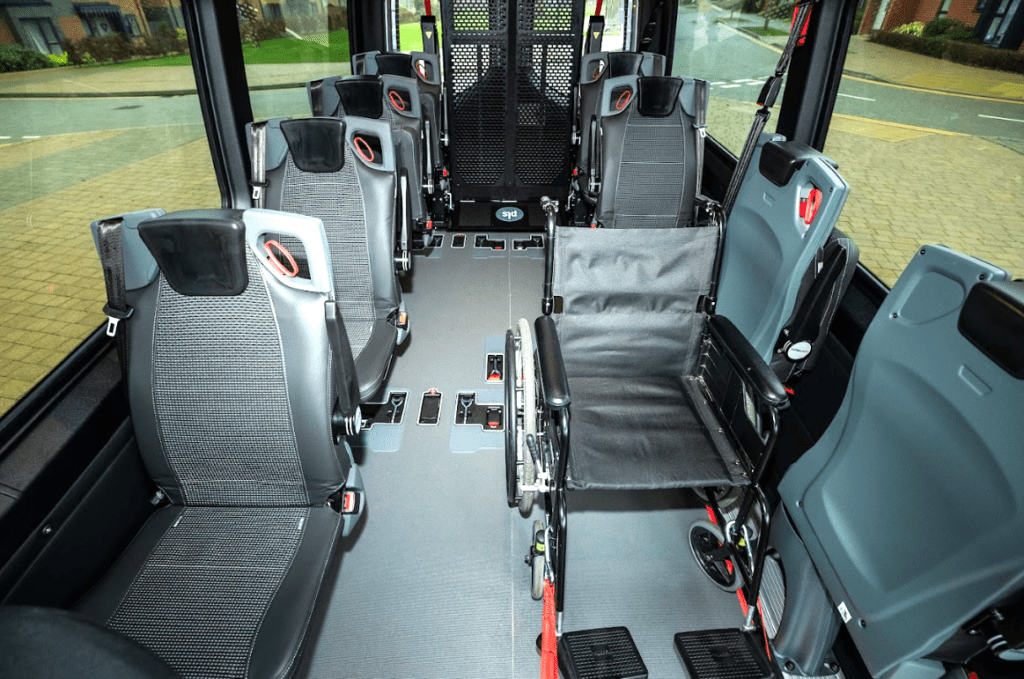
There is no standard pricing structure in the accessible minibus sector, so it is essential to compare several suppliers and understand exactly what you are buying. Wherever possible, seek independent mechanical checks and ensure spare parts and servicing are readily available.
Often, SEN providers will gravitate toward 16-seat low-floor vehicles and remove seats to increase wheelchair capacity. However, flexible models are now available that allow rapid reconfiguration without reducing the seating capacity. An online search will reveal a wide range of suppliers and brands, including Citroën, Ford, Renault, Mercedes-Benz and Iveco. Most minibuses are built on a standard van chassis and then converted by specialist manufacturers. When choosing a supplier, look for proven experience in accessible vehicle conversions. Poor build quality or unsupported conversions can result in frequent breakdowns, safety risks, and expensive repairs.
Funding is a significant concern for all school and community transport providers. Local authorities have specific duties to provide transport for children with SEND. A range of local and national schemes exist to support accessible and low-emission transport access to education, healthcare, and social inclusion. Across the UK and Scotland, councils and government bodies offer grants linked to community transport, SEN and disability provision, rural mobility and electric and zero-emission vehicles. It’s worth regularly checking local authority websites and specialist mobility providers for up-to-date funding opportunities.
Done well, transport becomes not a barrier, but an enabler.