







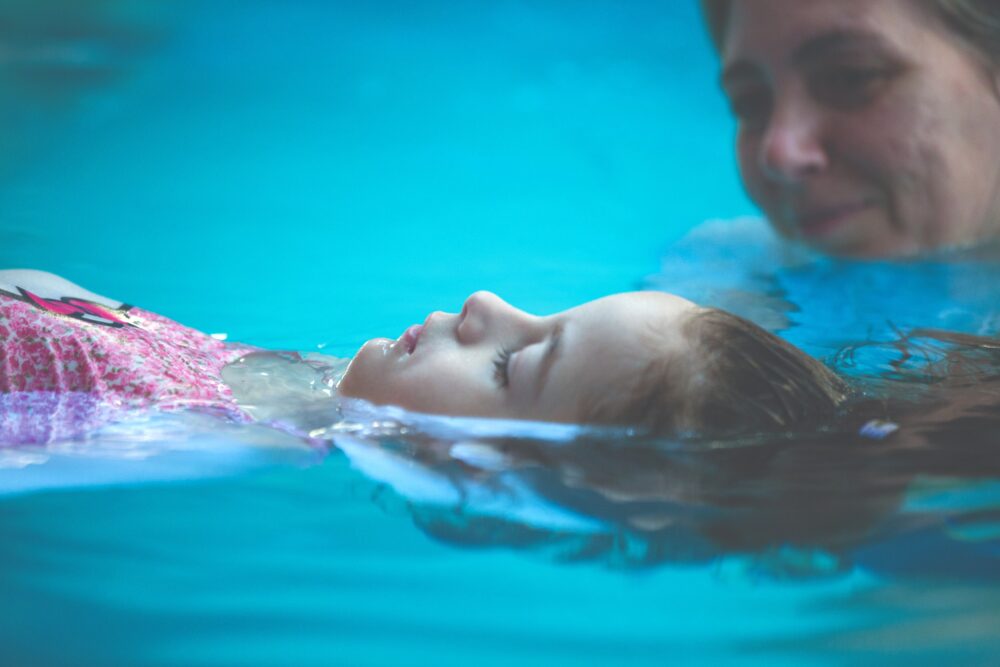
Alice Walton describes the therapeutic benefits of musical hydrotherapy for children with complex needs.
What happens if children experiencing aquatic therapy can also listen to—and feel—specially composed music under water? Musical Hydrotherapy can help children with profound disabilities to experience deep relaxation, increased motor and sensory skills, increased vocalisation, improved wellbeing, and sheer joy.

In Musical Hydrotherapy, speakers are placed in a hydrotherapy pool and sound is heard through them when any part of the head is placed in the water. The vibrations travel through the water and stimulate the inner ear directly, so the listener perceives the music as if they are hearing is from inside their head. The result is an all-body experience of sound that is immediate and finely detailed. Despite being in a public space, the listener feels as though they are in a private space—an almost womb-like environment. The vibrations can also be felt inside the body when it is in close proximity to the speakers. When this is experienced alongside Watsu-based body therapy, the participants enter a deep state of relaxation.

For the children themselves, the pleasure of the experience can take many forms. At Ivy House School in Derby in January 2024, teaching assistant Lyndsey described her first Musical Hydrotherapy experience as “remarkable…mind blowing. We use a lot of holistic approaches in the school, but this is on a different level…. so special. One particular child, she doesn’t like touch at all, she hadn’t been touched since September… but within five minutes she was embraced and sleeping”. Jess, another teaching assistant at the same school, observed: “I’ve got pupils who are tight and struggle to move their bodies, who all of a sudden are moving their bodies freely. I’ve got other pupils who are constantly fighting movement, can’t relax, can’t stay still, and yet in this environment they are still…relaxed…calm”.
Musical Hydrotherapy remains at the core of our programme today, and our philosophy is to enable schools and residential homes for children with complex needs to embed our practice into the heart of their curriculum. It has been wonderful to see students creating their own sounds, experiencing them underwater alongside the relaxation and wellbeing benefits of the pool-based activity—and then sharing their music with family and creating something for their peers to benefit from in their own pool sessions. We are now looking at ways to help schools—with and without their own pools—to create classroom-based listening therapies to promote similar relaxation and wellbeing effects. There is plenty more that we could say about what we see when we watch children with PMLD experiencing Musical Hydrotherapy, but let’s give the last word to a pupil from Valence School in Kent:

“The music feels like rainbows”.