



















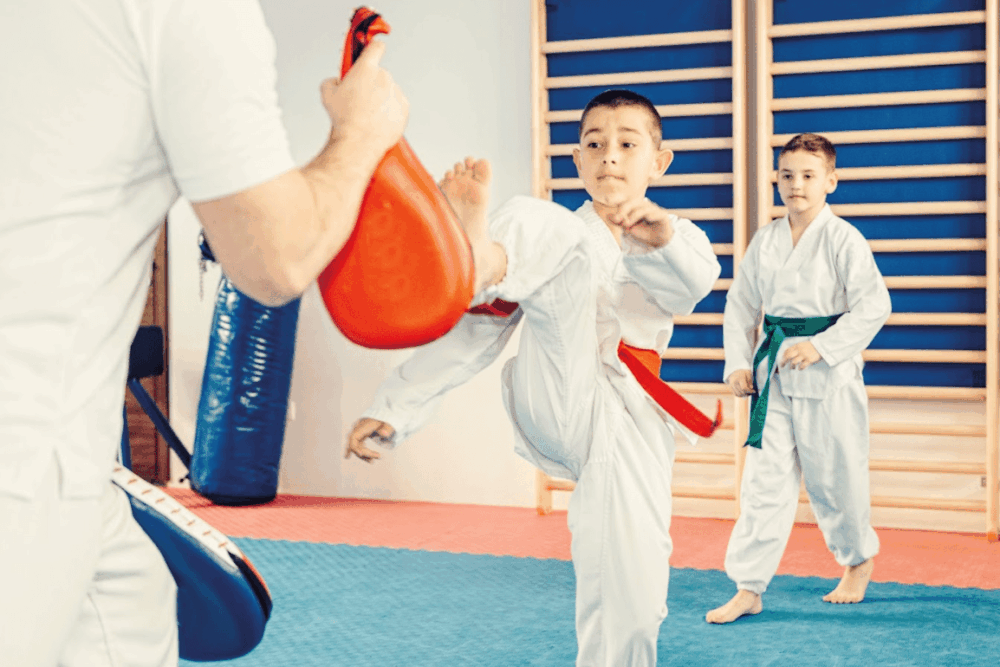
Vickie Simos looks at how a focus on martial arts can support teaching discipline, concentration and attention, especially for neurodivergent people.
Martial arts can help improve clinical symptoms in young people with autism spectrum disorder (ASD) and contribute to better management of ASD. After an initial getting-to-know-you session, my martial arts sessions usually start with me saying ‘tell me a story’. The sessions are low-demand, and there’s no pressure to perform. Throughout the sessions I ask the young person subtle questions ie about school, friends, things they do on the weekend. Just so I can get a feel of what they are like. We start a session with static stretches, and then there are some resistance exercises (2 x 10 repeats)—push ups, sit ups and squats. From there we work on some technical exercises. If we’re going to work on boxing, we learn how to make a fist, the three different punches and how to block the punches. The young person then has an opportunity to put on the gloves, where they learn three different four-punch combos. Lastly, we cool down with static and dynamic stretches.
In addition to being Neurodivergent, Michael had low self-esteem from years of school bullying. He was quiet, shy, sensitive, and non-sporty, introverted, depressed, and really flat. Right from our first session, we saw an instant change and he has been improving ever since. He now has friends, he plays sport, he’s learned new skills, and his confidence and self-esteem have improved. Eddie had level 2 Autism, ADHD and anxiety. From my perspective, he had a very negative mindset, he felt terrible every time he made a mistake. He also had low self-esteem and confidence. This has all changed now. He recognises his ability and his potential, he has a positive mindset, he is no longer so affected by making mistakes and he has grown in confidence. In his own words: Boxing has given me strength and courage. I feel more confident to talk to people and it’s so much fun. Evan had low self confidence and many sensory challenges.
I saw a positive change from the very first session. It’s like we unleashed the beast. He appeared more confident, and wanted to spar. He even spoke at a school assembly, something that usually caused him excessive anxiety. Martial Arts changed the way they saw themselves and how they saw the world around them. They were able to change their negative thoughts to positive ones, which included building confidence to improve self-esteem by creating new neural pathways (neuroplasticity). Note: Michael, Eddie and Evan are not their real names.
It has been shown that martial arts can be more conducive to cognitive improvement than physical exercise, and that martial arts interventions in the earlier stages of childhood may improve the regulation of neural networks involved in cognitive control. Children with ASD show improved socio-emotional competence such as communication, cooperation and engagement, and better executive functioning ability such as cognitive flexibility, inhibitory control and working memory and a lower aggressiveness, sadness, anxiety and hyperactivity.